Baglamukhi: The Mahavidya of Stillness, Speech Control, and Inner Power
- Neha Chauhan
- Apr 22
- 2 min read

Among the ten Mahavidyas, Bagalamukhi stands out as one of the most powerful and misunderstood. While many associate spirituality with growth, healing, and expansion, Baglamukhi represents a different kind of force—the power to stop.
She is not the energy that moves forward. She is the energy that halts what should not continue.
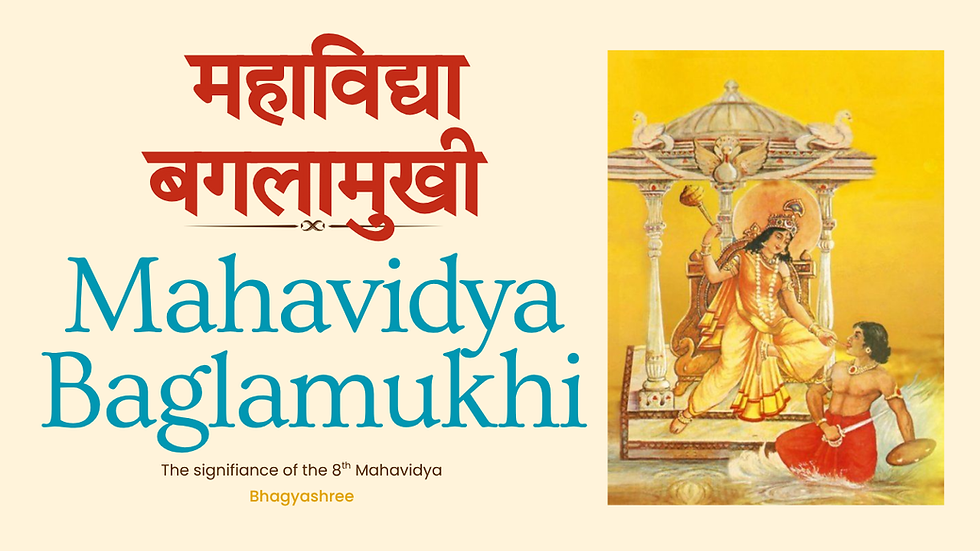
Who is Goddess Baglamukhi?
Baglamukhi is the eighth Mahavidya in the Dasha Mahavidya tradition. She is associated with stambhana, a Sanskrit term that refers to the act of paralyzing or stilling.
In traditional depictions, she is shown holding the tongue of a demon while raising a weapon. This imagery is deeply symbolic.
It represents:
control over harmful speech
interruption of destructive patterns
the ability to stop negative momentum
The Symbolism of Stambhana
In modern life, we are constantly encouraged to:
do more
think more
express more
But Baglamukhi introduces a different perspective.
Not every situation needs action.Not every thought needs continuation.Not every reaction deserves expression.
Stambhana is the power to:
pause
interrupt
neutralize
This is not suppression.This is conscious control.
The Power of Speech and Silence
Baglamukhi is deeply connected to speech.
Her act of holding the demon’s tongue symbolizes the control of words.
Words carry energy.They shape relationships, decisions, and outcomes.
Uncontrolled speech can create:
conflict
misunderstanding
emotional damage
Baglamukhi teaches that silence is not weakness. It is a form of power.
Psychological Interpretation
From a psychological perspective, Baglamukhi represents:
interruption of negative thought cycles
control over impulsive reactions
the ability to pause before responding
Many of the struggles people face today come from:
overthinking
reactive behavior
inability to stop
Baglamukhi addresses this directly.
She creates a moment where:
thoughts slow down
reactions pause
awareness increases
Internal vs External Enemies
Traditionally, Baglamukhi is invoked for victory over enemies.
However, the deeper interpretation is internal.
The real enemies are often:
self-doubt
repetitive negative thinking
emotional instability
By stopping these internal patterns, external clarity naturally emerges.
The Role of Discipline
Baglamukhi is not a passive energy.
She requires:
awareness
discipline
restraint
Without these, the attempt to “control” can become suppression.
True stambhana is not about forcing silence.It is about understanding when silence is needed.
Relevance in Modern Life
In a world driven by constant activity and noise, Baglamukhi’s relevance is profound.
She reminds us that:
stillness is necessary
pauses are powerful
silence creates clarity
How to Reflect on Baglamukhi Jayanti
Instead of focusing only on rituals, consider:
observing your thought patterns
noticing when you react impulsively
practicing conscious pauses
Conclusion
Baglamukhi is not the goddess of action.
She is the goddess of interruption.
She teaches that sometimes, the most powerful thing you can do is not to act—but to stop.



This was such a fantastic breakdown of Baglamukhi Mahavidya; I’m genuinely so grateful for this content. It's rare to find such clear and insightful explanations, and you've really captured her essence. I was nodding along so much, especially when you touched upon her power over speech. It reminds me of a time I was struggling with public speaking, and just meditating on her energy, visualizing her stillness, somehow helped me find my voice without losing my composure. It made a real difference https://www.vgccc.vic.gov.au/ I also found myself thinking about the practical application of these concepts. Perhaps a troubleshooting section for common challenges people face when trying to connect with Baglamukhi Mahavidya’s energy would be incredibly helpful for readers. It’s something…
This is such a wonderfully detailed exploration of Baglamukhi Mahavidya, and I truly appreciate the depth of care you've put into covering this topic! I rarely come across discussions about her with this much thoughtful consideration. It's made me think about how her energy relates to moments of intense public speaking I've experienced; the idea of harnessing that still, focused power is incredibly appealing https://www.rba.gov.au/payments-and-infrastructure/ Expanding on your points, a comparative analysis of different devotional approaches to Baglamukhi would be fascinating. It feels like there are so many layers to her practice, and seeing how various traditions interpret and engage with her would really enrich my understanding. Additionally, an actionable summary, perhaps highlighting key principles or practices, would be a…
I found this blog post quite informative relevant information The way you've broken down the topic makes it accessible for everyone https://en.wikipedia.org/wiki/Web_design Thanks for sharing your knowledge!